
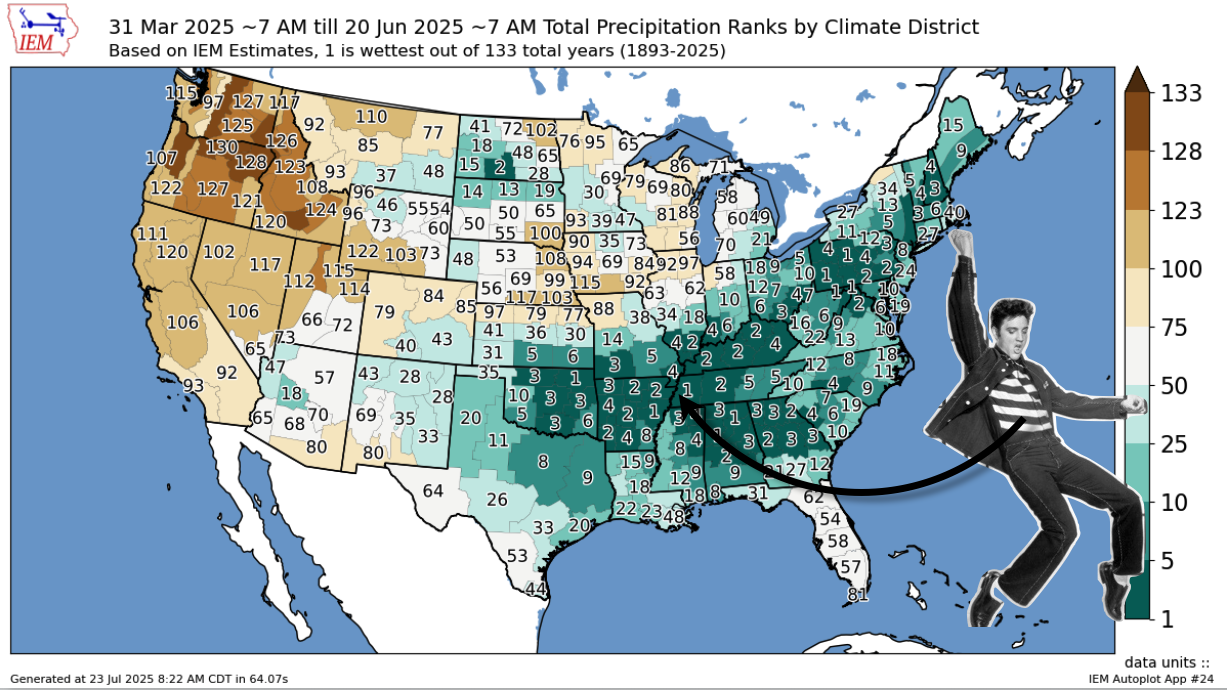
This post is for Midwest, I-state farmers... My colleague, Matt Reardon, and I have been trying to come up with a way of remembering one of the more dominant signals for early summer (June-July) heat/drought risk. Matt came up with the term "The Elvis Rule" so all credit goes to him for naming it (apparently we are both Elvis fans though) and it refers to spring drought conditions in the MidSouth centered on Graceland. To be clear - THIS IS NOT A GUARANTEE - but there is historical evidence and a meteorological explanation behind Delta/MidSouth drought in April and May followed by I-state drought in June and July. If the MidSouth does not recover moisture from spring rainfall, drought risk increases in the I-states because any early summer moisture return from the Gulf will first be deposited over the MidSouth before reaching the Midwest. Secondly, if drought builds in the MidSouth in spring, there is a positive feedback due to the lack of moisture in the soil where the sun's heat is used to warm the ground rather than evaporate the water in the soil. The net effect is to increase the temperature, lower the humidity, and build a ridge of high pressure over the region. That ridge will have staying power too once established and it will typically only break when a high impact weather event (derecho or hurricane) is forced to pass through the region. In 2012, May rainfall deficits plus heat rapidly built drought in the MidSouth which moved north into the I-states by July. On the flip side, Spring 2025 rains in April/May erased the drought risk for June-July in the I-states by saturating the air over the MidSouth. The figure shows the April 1 - June 20 rainfall stats from 2025. Historic flooding in the MidSouth drastically lowered the probability of June-July drought in the I-states (which, if you remember, Iowa had one of its wettest Julys on record).