
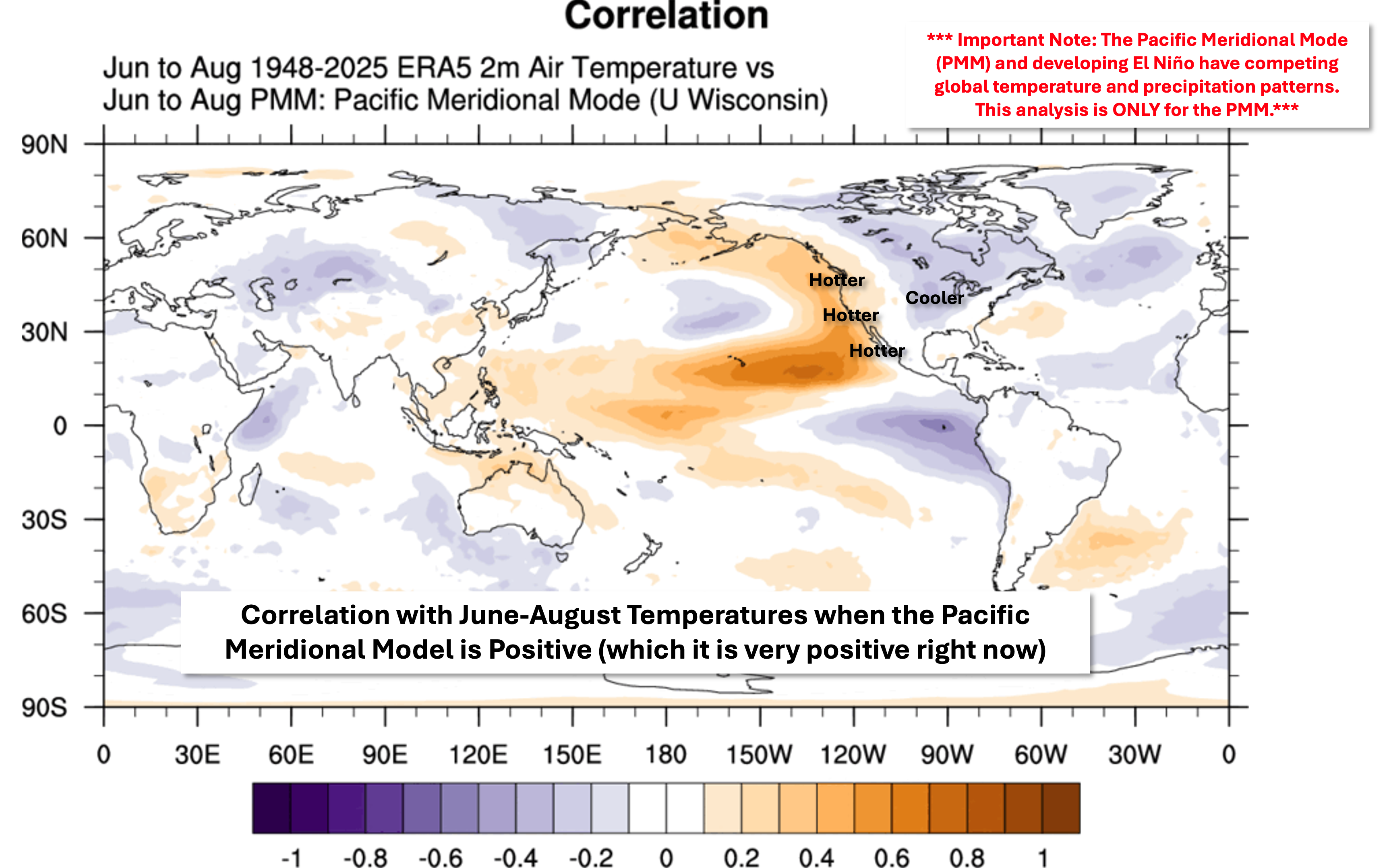
Atmospheric scientists have developed indexes for nearly all weather events. You've heard of ENSO (El Niño and La Niña) and probably the PDO (Pacific Decadal Oscillation) and many others, but this year you will likely hear us talking a lot about the PMM (Pacific Meridional Mode). The PMM monitors the changes in sea surface temperature anomalies that extend from the California, Baja, and Mexico coasts toward the equatorial Pacific. Changes in the ocean temperatures in this region have historically been correlated with weather patterns across North America and when the PMM is negative (cold sea surface temperature anomalies) summers are typically less hot across the West while the Midwest is hotter and drier. If the ocean temperatures throughout the PMM region are hotter than normal, the West has significant risk of a very hot summer while the Midwest is typically cooler and stormier. As of late April the heat content in the PMM is pushing toward record territory (a so-called Marine Heat Wave) and as El Niño develops all summer, the heat content in this region should be reinforced. A likely scenario for the summer temperature pattern is shown above using the historical correlations June-August. We are going to have to watch the Gulf of Alaska too - if it goes warm for summer, the heat risk out West increases even more.